
The Best Things to Do in Tübingen Germany
Tübingen is a medieval city shaped by a centuries-old university.
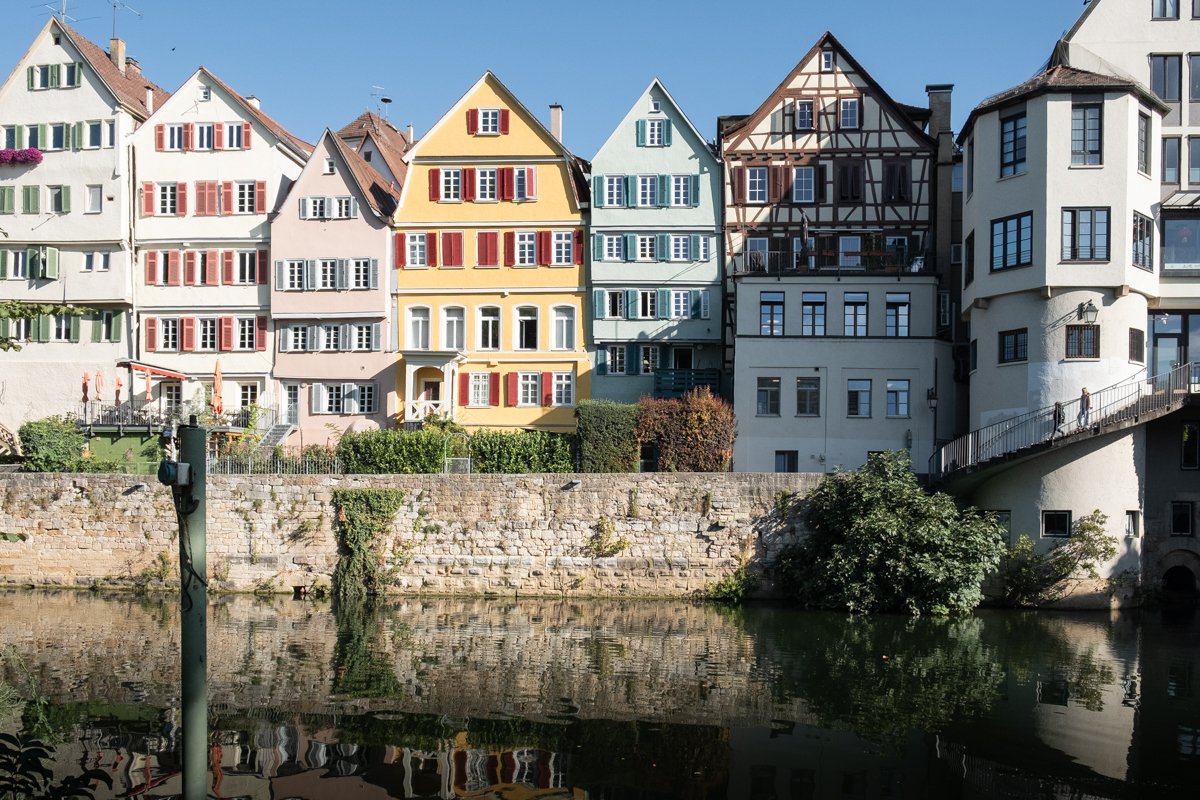
Colorful houses line the Neckar. A yellow tower rises beside the water. Long wooden boats drift beneath rows of trees. A castle looks down over a maze of lanes and half-timbered houses.
The University of Tübingen has shaped the city through important discoveries, famous thinkers, and traditions that continue today.
In a laboratory inside the castle, a young scientist isolated a substance that would become central to our understanding of DNA. Some of Germany’s most important poets and philosophers once walked these streets. And the Stocherkähne gliding along the Neckar are still tied to Tübingen’s student traditions.
The mix of old and young is one of the things I liked most about Tübingen. You can walk along cobblestone streets lined with Fachwerk houses. But turn a corner, and you might find a dive bar, street art, a concert poster, or a bookstore. Tübingen feels old and hip at the same time.
For a first visit, I would focus on five essential experiences. Then add a few smaller sights if you have more time.
The Quick List
- Explore Tübingen’s old town
- Visit Schloss Hohentübingen
- Take a Stocherkahn ride on the Neckar
- Walk the Neckarinsel
- Make the trip to Bebenhausen
The 5 best things to do in Tübingen
01. Explore Tübingen’s old town
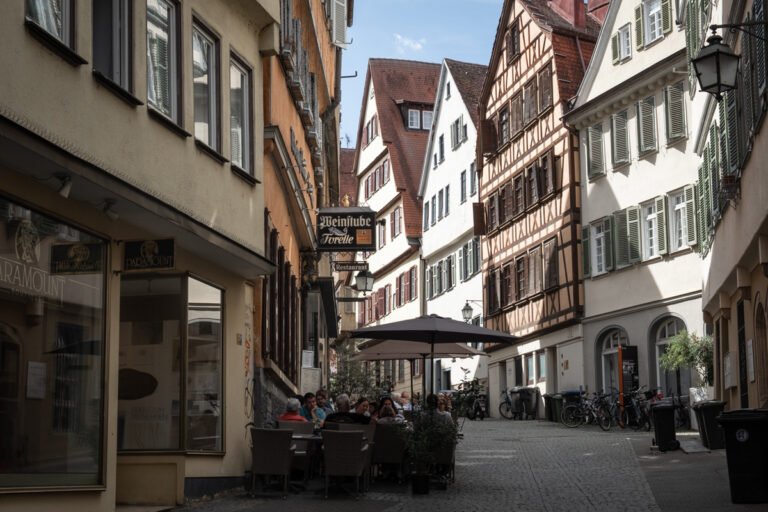
If you do only one thing in Tübingen, wander through the old town.
Tübingen’s Altstadt sits beside the Neckar in a jumble of narrow streets and half-timbered houses.
Start at the Marktplatz, where the painted 15th-century Rathaus overlooks the Neptune Fountain. Don’t miss the astronomical clock on its facade. Created by astronomer Johannes Stöffler in 1511, it still tracks the phases of the moon and the sun’s position in the zodiac.
Continue to the Holzmarkt and Stiftskirche St. Georg. The steps beneath the church are of Tübingen’s natural gathering places.
Across the square, look for Antiquariat Heckenhauer. Hermann Hesse arrived in Tübingen in 1895 to begin a bookselling apprenticeship here. The Hesse-Kabinett inside explores his years in Tübingen.
Then wander away from the major sights. Take whichever narrow street looks interesting. Explore the crooked beams, old facades, and passages disappearing between buildings.
Know before you go
- Allow: At least 2 hours, although you could spend half a day here
- Cost: Free
- Best time: Morning for quieter streets and photographs
- Getting there: The Altstadt is an easy walk from Tübingen Hauptbahnhof
- Pair it with: Schloss Hohentübingen and the Neckarinsel
02. Visit Schloss Hohentübingen
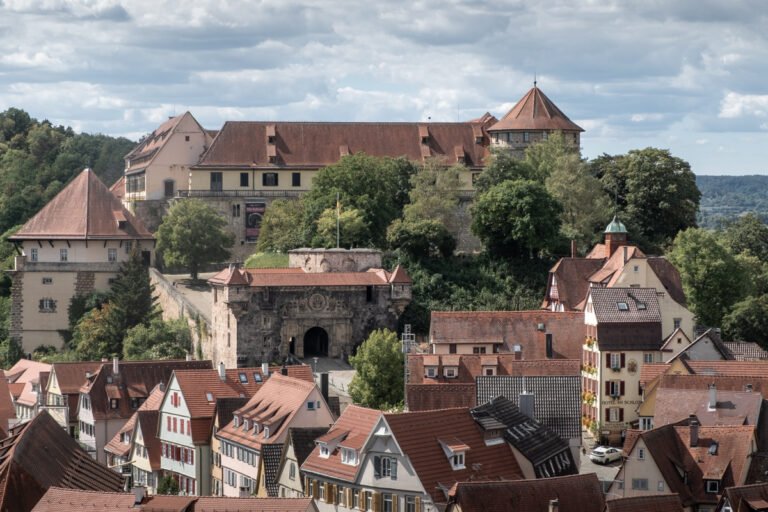
Above the old town, Schloss Hohentübingen is worth the climb for much more than the view.
A fortress was first documented here in 1078. Later, the Counts Palatine of Tübingen ruled from the hill. The town and castle then passed to the Counts of Württemberg. During the 16th century, the medieval fortress was transformed into the Renaissance castle you see today.
The castle now belongs to the University of Tübingen. Inside is an unusual combination of archaeology, science, and local history.
The Museum Alte Kulturen displays tiny figures carved from mammoth ivory during the Ice Age. Discovered in caves in the Swabian Alb, some are around 40,000 years old. They are among the oldest known figurative artworks created by humans.
The museum is worth visiting just for the Ice Age figures. But the size and scope of the museum surprised me. The university’s collections span thousands of years. They include ancient Egyptian artifacts, Mesopotamian cuneiform tablets, and rooms filled with sculptures. I spent much more time here than I expected.
In another part of the castle, a much less dramatic room tells a remarkable scientific story.
In 1869, young Swiss scientist Friedrich Miescher was working in a laboratory here. He isolated an unknown substance from the nuclei of cells.
He called it Nuklein.
Miescher didn’t yet understand its significance. He had isolated nucleic acid, the class of molecules that includes DNA and RNA. The Schlosslabor where he made the discovery still exists inside the castle. It is open to the public.
Then there’s the enormous wine barrel in the castle’s cellar. Built in 1549, it holds the Guinness World Record as the world’s oldest surviving giant wine barrel.
It somehow makes perfect sense in a castle owned by a university.
Know before you go
- Allow: Around 1½–2 hours if you visit the museum
- Cost: €5 for adults for the Museum Alte Kulturen
- Hours: Wednesday–Sunday, 10 am–5 pm; Thursday until 7 pm
- Getting there: Walk uphill from the Altstadt via Burgsteige. The climb is short but steep and partly cobbled
- What to know: You can only visit the giant wine barrel in winter because of a nearby bat colony. Guided visits currently run from November 1–March 15 and require a separate ticket
- Pair it with: The Altstadt before your visit and the Neckarfront afterward
03. Take a Stocherkahn ride on the Neckar
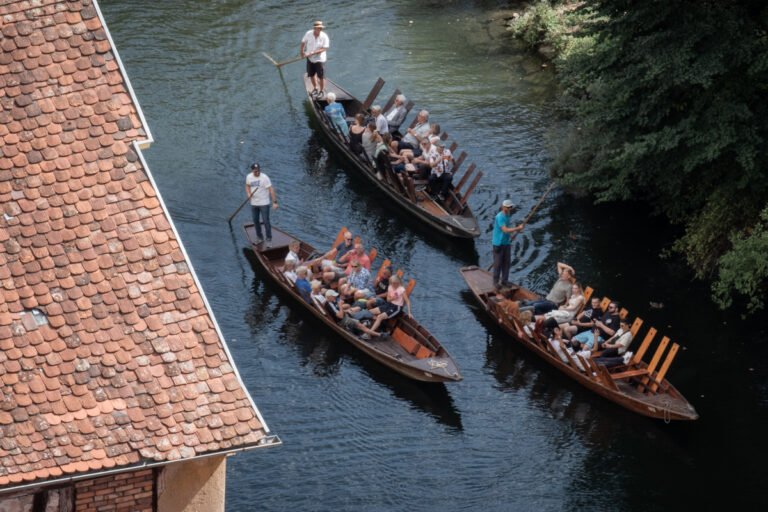
Some places have an experience that immediately belongs to them.
For Tübingen, it’s the Stocherkahn.
These long wooden boats glide along the Neckar. Someone standing at the back pilots the boat by pushing a wooden pole against the riverbed.
The comparison to Venice is inevitable. But Stocherkähne have their own character and a long association with Tübingen’s university and student fraternities.
From the boat, you get a different view of the city.
The city slips by you. The yellow Hölderlinturm sits beside the water. Historic buildings rise behind it. Above everything, Schloss Hohentübingen appears on the hill.
You don’t have to charter an entire boat or organize a group. Individual travelers can reserve seats on scheduled public rides during the main season.
I think the Stocherkahn ride is worth doing, but an hour is about right. Everyone sits on hard wooden boards. It’s charming for the first part of the ride and much less charming by the end.
But experiencing the ride and seeing Tübingen from the water is worth the uncomfortable seat.
Know before you go
- Allow: About 1 hour
- Season: Regular public rides operate May–September. In good weather, Saturday rides may run from mid-April into mid-October.
- Times: Daily at 1 pm, with another 5 pm ride on Saturdays
- Cost: €13 for adults; €11 for children age 12 and under
- Getting there: Public rides leave from the Casino landing at Wöhrdstraße 25
- What to know: Buy public-ride tickets in advance. Private operators also offer Stocherkahn rides.
- Pair it with: The Neckarinsel
04. Walk the Neckarinsel
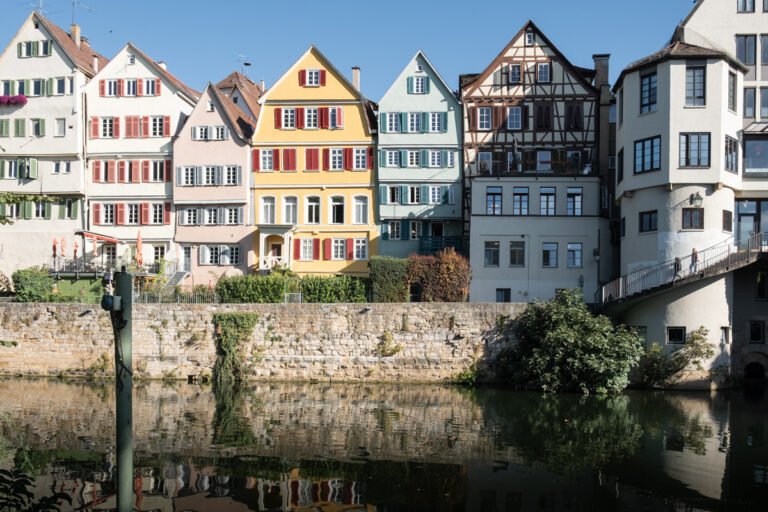
You don’t have to get in a boat to enjoy one of Tübingen’s best experiences along the river.
Start on the Neckarbrücke, where you get the classic view toward the Neckarfront.
This is the image of Tübingen you’ll see on postcards. Colorful houses line the river. The yellow Hölderlinturm sits at the water’s edge. Church towers and the castle rise above the city.
Cross onto the Neckarinsel and walk beneath the trees of the Platanenallee.
Seeing Tübingen from here feels different from seeing it from a Stocherkahn. On the boat, the town moves past you. On the island, you can slow down and watch life on the river instead.
Stay awhile.
Find a bench, have a snack, and watch the Stocherkähne pass beneath the trees.
Know before you go
- Allow: 30 minutes to an hour
- Cost: Free
- Best time: Late afternoon for softer light along the Neckarfront
- Getting there: The Neckarbrücke lies between the Hauptbahnhof and the Altstadt
- Pair it with: A Stocherkahn ride
05. Make the trip to Bebenhausen
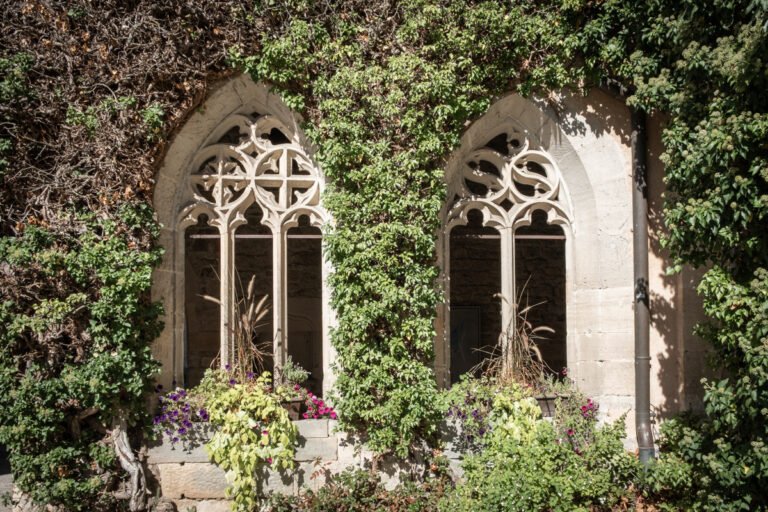
For a different side of Tübingen, make the short trip to Bebenhausen.
The little village sits beside the Schönbuch forest outside Tübingen. It feels far removed from the university town.
Its centerpiece is Kloster Bebenhausen. Founded in the late 12th century, the monastery was later taken over by the Cistercians. The medieval complex is well preserved.
The story didn’t end with the monks.
Parts of the former monastery were later transformed into a royal hunting palace. After the Württemberg monarchy ended, the last king and queen made Bebenhausen their home.
That combination, medieval monastery and royal residence, makes the complex particularly interesting.
Leave some time to wander through the village itself.
Know before you go
- Allow: At least half a day to see the monastery, palace, and village without rushing
- Cost: The palace tour currently costs €9 for adults; monastery admission is separate
- Getting there: Bebenhausen is a short bus ride from central Tübingen
- What to know: The palace interiors can only be seen on a guided tour, and schedules vary by season
- Pair it with: A walk in the Schönbuch forest if you have more time
Map of the best things to do in Tübingen
Am Markt, Altstadt, Zentrum, Tübingen, Landkreis Tübingen, Baden-Württemberg, Germany
Neckawa, 25, Wöhrdstraße, Trautwein-Eck, Zentrum, Tübingen, Landkreis Tübingen, Baden-Württemberg, 72072, Germany
More things to do in Tübingen
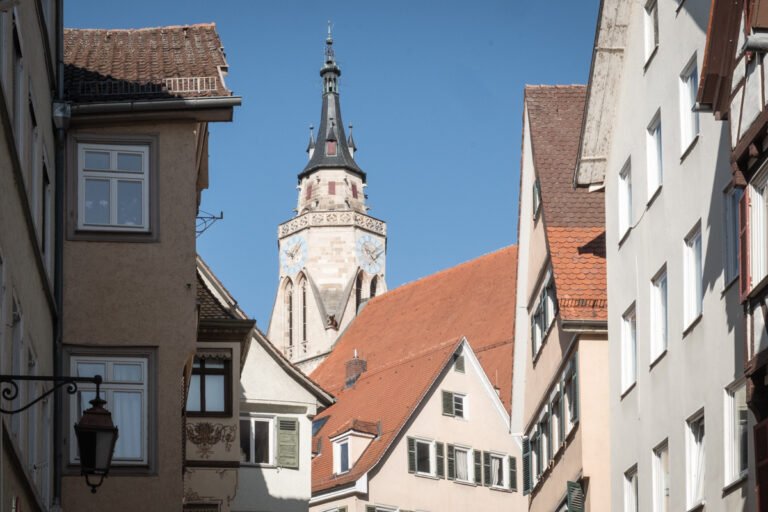
Once you’ve covered the essentials, there are several smaller sights worth adding.
Climb the Stiftskirche tower
For one of the best views over Tübingen, climb the 169 steps to the top of the Stiftskirche St. Georg tower. From the viewing platform, you can look across the red roofs and narrow streets of the Altstadt. It’s a strenuous climb, and some of the stairs are uneven, but there are several places to stop and rest along the way. One tip from personal experience: try not to be standing in the belfry when the bells start ringing.
Visit the Hölderlinturm
The yellow tower beside the Neckar is one of Tübingen’s most recognizable landmarks. Poet Friedrich Hölderlin lived here for the final 36 years of his life. After a lengthy stay in a Tübingen clinic, carpenter Ernst Zimmer took him into his household in 1807. Today, the Hölderlinturm contains a museum devoted to Hölderlin’s life and work. It’s particularly worthwhile if you’re interested in Tübingen’s literary history.
Visit the Hesse-Kabinett
Step inside the small museum devoted to Hermann Hesse’s years in Tübingen. The Hesse-Kabinett preserves parts of the historic bookshop where Hesse worked as an apprentice. The old book storage area and spiral staircase help you imagine his time here. Admission is free. And because it’s in the old town, it’s an easy addition for literary travelers.
Explore the Stadtmuseum
Tübingen’s city museum explores local history and the work of silhouette animator Lotte Reiniger. Admission is free. It’s a good choice if you want to learn more about the city or need an indoor stop during bad weather.
See what’s on at Kunsthalle Tübingen
The Kunsthalle specializes in changing art exhibitions rather than a large permanent collection. Check the current program to decide if it belongs on your itinerary.
Visit the botanical garden
The University of Tübingen’s botanical garden sits outside the Altstadt. Around 10,000 plant species grow across its outdoor gardens and greenhouses. Admission is free, and the garden is open year-round.
Discover the BOXENSTOP Museum
Cars, motorcycles, bicycles, historic toys, and model railways fill this quirky private museum. It’s more specialized than Tübingen’s historic attractions. Save it for a longer stay, a rainy day, or if you’re particularly interested in transportation history.
Walk Through Tübingen’s Vineyards
Wine has shaped the landscape around Tübingen for centuries. Around Unterjesingen, vineyards climb the sunny slopes above the Ammertal. The Wengertwegle takes you through steep vineyard terraces, orchards, and forest. Save this for a longer visit when you want to see a quieter, more rural side of Tübingen.
Seasonal Things to Do in Tübingen
A few annual events are worth planning a visit around.
See the Stocherkahnrennen
Each year in late spring or early summer, more than 40 teams crowd into Stocherkähne for Tübingen’s annual race. Before the race, the teams parade along the river in elaborate costumes. There are prizes for the winners. The losers have to drink cod-liver oil.
Visit the Umbrisch-Provenzalischer Markt
For five days each September, producers from Aix-en-Provence and Perugia bring French and Italian food, wine, and crafts to the Altstadt. More than 100,000 visitors attend each year, making it one of Tübingen’s biggest annual events.
Watch the Tübinger Entenrennen
Every October, thousands of yellow rubber ducks race down the Neckar to raise money for charity. Sponsor a duck or find a spot along the river to watch.
Visit chocolART in December
Tübingen’s Altstadt turns into a chocolate festival in early December. Chocolatiers bring pralines, hot chocolate, chocolate art, and unusual creations to try.
Visit the Tübingen Christmas Market
The Tübingen Christmas market takes over the Altstadt for one weekend each December. More than 300 stalls wind through the historic streets with food, gifts, and Glühwein.
Final thoughts: Is Tübingen worth visiting?
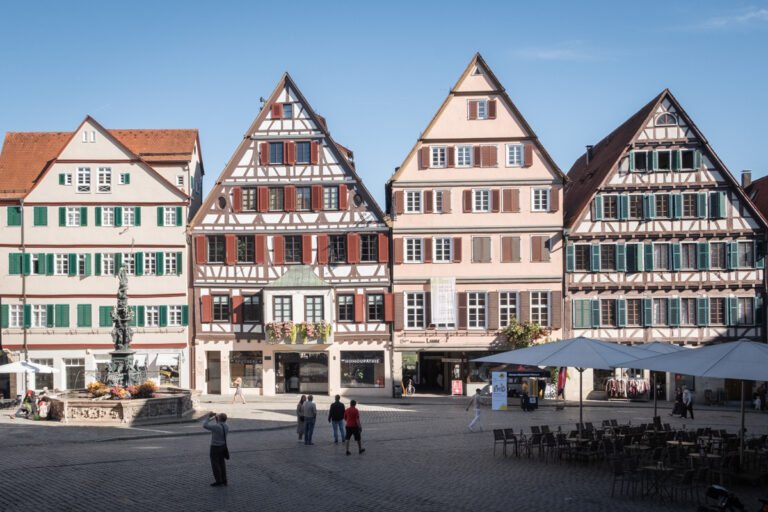
Absolutely.
Tübingen has many of the things people picture when they imagine a medieval German town. Half-timbered houses. Narrow streets. A hilltop castle.
What makes it most interesting is the contrast.
Centuries of university life sit right alongside the medieval city. Students fill the streets and riverbanks. Old academic and student traditions are still part of everyday life.
If you only have one day, spend it in the Altstadt, Schloss Hohentübingen, and along the Neckar. Add a Stocherkahn ride when the boats are operating.
That’s enough for a very good day.
When you return another time, and you will want to, add Bebenhausen, a vineyard walk, or some of the smaller museums.
